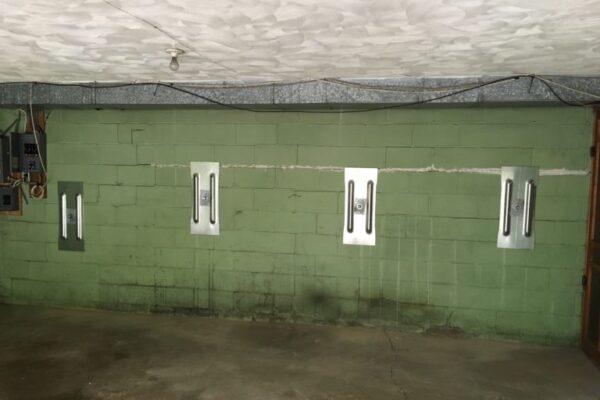
When Hydrostatic pressure builds up in the soil, or the soils expand with water saturation, over time it can push against your basement and foundation walls and cause bowing. If not solved having a bowing or a leaning wall can cause serious structural damage in the rest of the home.
Mathews Wall Anchor has been correcting bowing and leaning walls for over 30 years in and around Pittsburgh PA, Ohio, and West Virginia.
Foundation Correction - Wall Anchors
The structure can be stabilized or restored back to its original position using a Wall Anchoring System.
Wall Bowing can be corrected using wall anchors that are manually and machine driven out past the active zone of moving earth at a downward angle. Wall Anchors provide supplemental lateral force to help stabilize bowed and cracked walls. This installation is quickly installed using hand held equipment and requires minimal excavation or disturbance to the yard.
To Learn more about our foundation piering service, foundation crack repair service, or just more about Wall Anchors please call or email us. We will be happy to answer any questions you may have. |
|
How Wall Anchors WorkThe Matthew's Plate Anchors are designed to stabilize cracking and bowed foundation walls. The inside wall plate is fabricated from 10 gauge hot-rolled steel and measures 12” X 26”. The wall plate has two embossed reinforcing ribs for additional stiffness, plus a 4” square, 10-gauge square washer is included for added strength.

The Plate Anchor, fabricated from two 10-gauge plates, has four reinforcing ribs and four cleats providing approximately 430 square inches of soil bearing surface. The wall plate and Plate Anchor are connected by a 3/4” diameter continuously threaded tie rod and secured with nuts. The Plate Anchor assembly is hot dipped galvanized for protection against corrosion. The Plate Anchors are the most economical method for providing supplemental lateral force to help stabilize bowed and cracked walls. This installation can be quickly installed using handheld equipment and requires minimal excavation or disturbance to the yard.
|